
Architecture Standards
6 min
Architecture standards provide the guardrails and a common language that keeps the organisation’s enterprise landscape coherent, secure, and cost-effective. It allows teams across the enterprise to make decisions in a consistent way, using approved processes, applications, technologies, information, patterns, and approaches.
Without agreed standards, teams can build and implement differently. Over time this leads to unnecessary complexity, duplicated effort, higher risk, and a landscape that becomes harder and more expensive to change.
Why have architecture standards?
- Consistency in how the organisation works
Common processes, definitions, and patterns mean services are delivered the same way everywhere, improving quality and reducing confusion. - Interoperability across business and IT
Standard processes, data rules, and integration approaches ensure activities, information flows, and systems all fit together coherently. - Improved efficiency and reduced duplication
Teams avoid reinventing solutions, processes, or technologies. This reduces effort, costs, and operational waste. - Better decision-making through consistent data and terminology
Standard data definitions and business language eliminate ambiguity and support clearer, faster decisions. - Lower risk and stronger compliance
Agreed standards for processes, controls, and technology reduce errors, security issues, and regulatory concerns. - Faster change and easier scaling
When everyone uses standard patterns (business and technical), improvements and new capabilities can be delivered more quickly and with fewer surprises. - A more manageable and future-proof landscape
Standardisation reduces complexity, making the organisation easier to evolve, integrate, and modernise over time.
Architecture standards may seem bureaucratic, but they are actually the practical mechanisms that help the organisation build solutions that are reliable, manageable, and aligned to strategic direction.
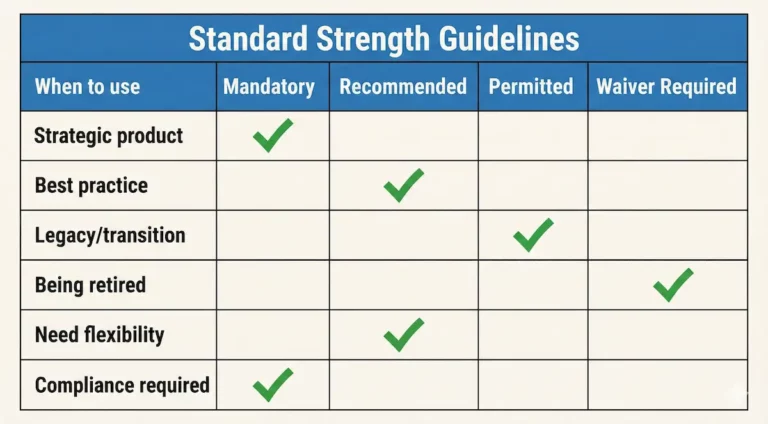
Your standards may look like below. Note in Essential you can set your own strengths.
Creating in Essential
In Essential you can map standards against any instance in the business, application, technology or information/data layers. There are various standard types defined.
If required, you can scope standards in two ways:
- By Organisation (sm_organisational_scope), e.g. this applies to Finance only
- By Geography (sm_geographic_scope), e.g. this applies in the US only
You can define the Standard Strength that applies to the standard, e.g. Mandatory, Not Permitted, etc.
In Cloud/Docker you can set standards with the editors, e.g. the Application and Technology Product editors have standards tab. In OS you set the items associated with the standard by selecting the standard and selecting the slot related to the instance type you are associating with this standard. The instance will have a red box around it (varies by standard). Alternatively, use the Import Utility, the spreadsheet and spec are on the free resources page.
Note, when setting application standards we usually set the standard at the Application Provider Role level not the application level (you can still do application level). Why do we do that? One example is Workday that has both HR and Finance capabilities. If you set Workday as a mandatory standard for the organisation the does that apply to HR and Finance or just one of them? If you only want it as a standard for HR, because you use Oracle’s Finance solution, you will need to set the standard on the HR related Application Provider Roles for Workday.
Additionally, technology is similar, use the Technology Provider Role, this means that you can say, for example Tomcat can be a Servlet & JSP Container and an HTTP Web Server (amongst other things). You may want to specify that you can use it for the former but not the latter. The Technology Provider Role allows you to specify the different uses of Tomcat and set standards for each
Updated 10 December 2025