
Why EA Communication and Knowledge Management do not have to be mutually exclusive
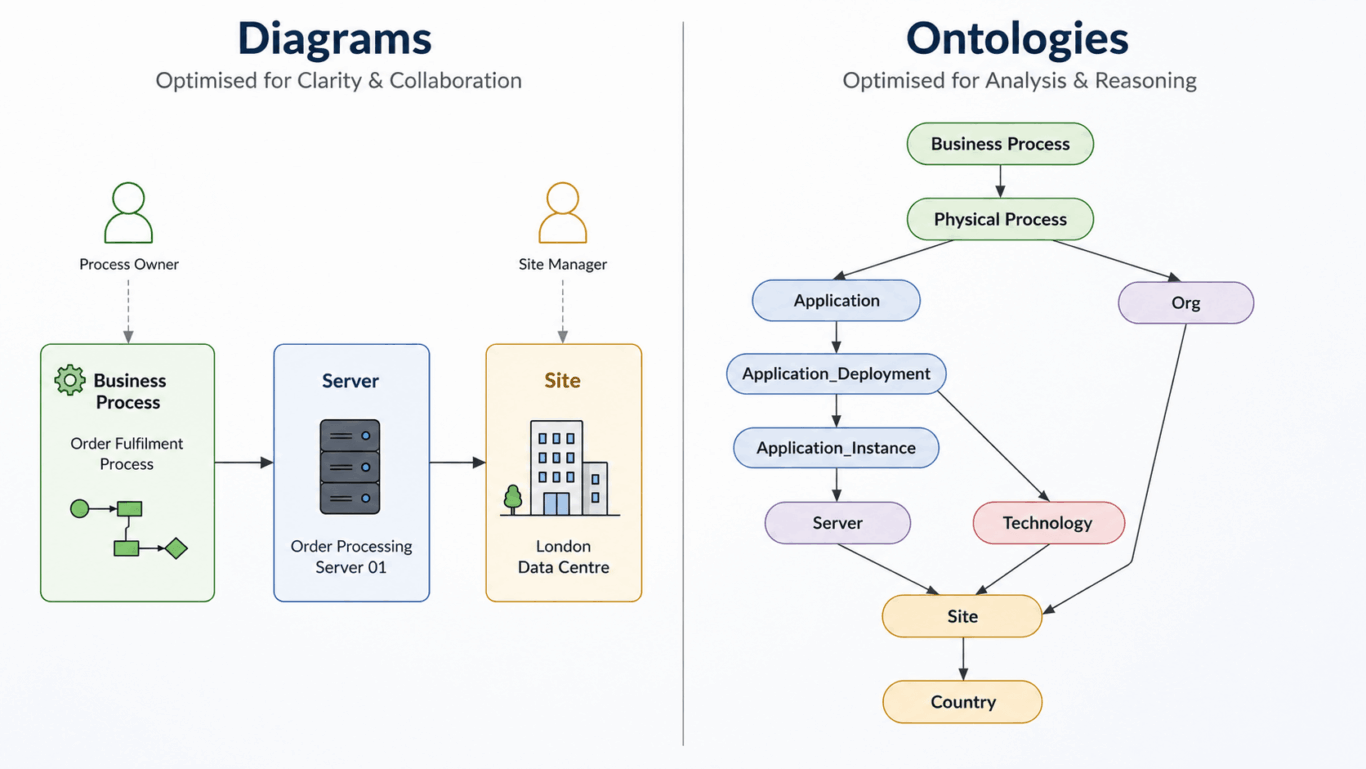
Diagrams are a key part of enterprise architecture, they convey information simply and are great for communication, but the activities that make diagrams valuable are often quite different from the activities that modelling a high-quality ontology requires.
As EAs, we usually use diagrams to answer a specific question, to design a new solution, to communicate with stakeholders, etc. They are about providing clarity to the audience, and often, purposely, simplify reality to ensure that the key message can be easily conveyed and understood.
An ontology has a different priority, which is to capture the relationships and meaning of the people, process, systems, data, strategy, plans, etc of the enterprise, in order to be able to support questions from many different perspectives, many of which may have not yet been asked. Diagrams are often a slice into that broader knowledge base
So, diagrams optimise for communication and collaboration, whereas ontologies optimise for knowledge management and analysis.
Organisations have a choice between:
- Creating diagrams quickly to support projects and decision-making
- Investing the additional effort needed to maintain a structured, semantically consistent repository of knowledge
Architects often choose the first option because it delivers immediate value, while maintaining an ontology can feel like a lot of work with benefits that are realised later – although this is a misnomer (see our previous blog, Getting value from EA).
The point people miss is that diagrams and ontologies are actually compatible. Most tools and processes view them as different – either you create a useful diagram, or you maintain a useful knowledge base. Alternatively, tools describe themselves as ontologies, when in fact they are just modelling tool, e.g. showing a server supporting a business capability is semantically wrong, you are modelling for communication, but a Business Process supporting a Business Capability is semantically correct.
The opportunity for EAs is to make diagram creation and managing and maintaining the ontology the same thing, i.e. model in a way that is semantically something that automated reasoning can be overlaid on top of. At this point you can have deep impact analysis, AI-driven insight based on semantically correct data and you can still have your ontology-based diagrams to communicate, collaborate and design.