


Essential helps CIOs, enterprise architects, transformation leaders and technology teams to gain visibility across applications, capabilities, technology, risk and change initiatives. Essential enables:
- Capability-based planning
- Strategic alignment
- Application portfolio visibility
- Technology rationalisation
- AI governance and readiness
- Transformation roadmapping
- Operational risk visibility
Better insight means that smarter decisions can be made, faster transformation can happen and stronger governance can be implemented.
Explore Your Role >>
Key Roles

CIO/CXO – Technology Transformation & Strategic Visibility for executives
Executives need clear visibility into business investment, operational risk, cloud adoption and transformation priorities across the enterprise.
How Essential helps
- Understand business impacts
- Understand application and technology dependencies
- Reduce duplication and technical debt
- Support cloud and platform transformation
- Align IT investment to business requirements
- Govern AI and emerging technologies
- Improve executive decision-making

Enterprise Architecture / Enterprise Architects – Enterprise Architecture Governance & Planning
Enterprise architects use Essential to model, analyse and govern applications, capabilities, technology and strategic change across the organisation.
- Application portfolio management – effective application rationalisation
- Capability modelling – business capability models, application, technology and information reference models
- Architecture governance – based around application and technology standards
- Technology lifecycle planning
- Reference architectures
- Dependency analysis
- Standards management
Enterprise Architects need to understand how people, processes, data, applications and infrastructure interact across a business. As an EA Management tool, Essential captures and joins together these different elements to enable an enterprise architect to spot opportunities to improve, reduce risk and assess the impacts of planned changes to the operating model. The interactive views and dashboards can be used to drive digital transformation, understand how to leverage emerging technologies, ensure operating model alignment, manage compliance, drive agility, analyse the impact of automation; there is no shortage of ways in which you can use Essential to add value.

Transformation & PMO Teams – Transformation Planning & Portfolio Coordination
Transformation teams need to understand how projects, applications, technologies and business capabilities interact across the enterprise. With Essential, digital transformation planning becomes easier
Outcomes
- Better portfolio visibility
- Reduced delivery risk
- Improved dependency management
- Faster impact assessment
- Clearer transformation roadmaps
The ability to visualise the business capability model and overlay key areas such as strategic goals, potential process automation opportunities or how applications support the business and understanding business change impact is key to understanding how to improve efficiency and reduce costs. This strategic view of the business allows the transformation teams to engage with senior leaders across the business and IT to create compelling options to plan and implement architectures in line with strategic business goals
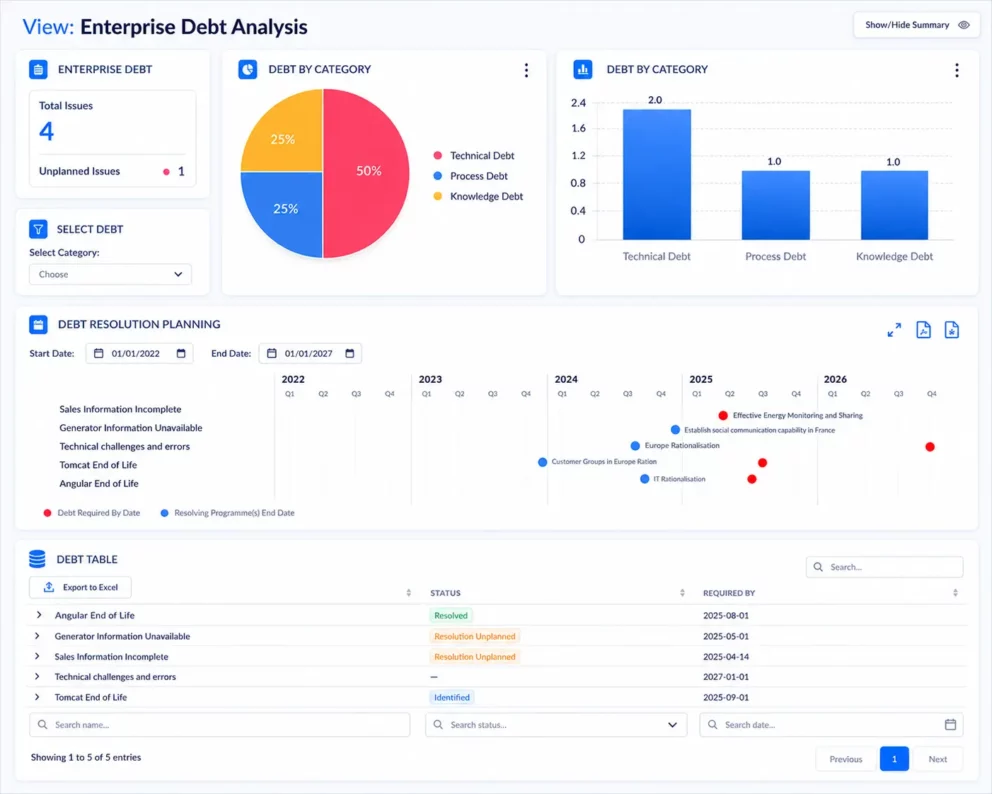
Risk, Governance & Operational Resilience – Operational Risk & Technology Dependency Visibility
Risk and governance teams use Essential to understand operational dependencies, technology exposure and critical business impacts.
Key capabilities
- Dependency mapping
- Operational resilience
- Critical system visibility
- Third-party risk understanding
- Governance reporting
- Technology risk analysis
BCP testing, DORA compliance, and a clear understanding of critical business processes and services help organisations identify where enterprise and technology risks exist, along with the critical dependencies that support them. This visibility enables organisations to better assess, prioritise, and respond to risk. Essential helps organisations structure and organise their data in a way that simplifies and strengthens this process.

AI Governance & Readiness – AI Transformation & Governance
Organisations adopting AI need visibility across applications, data, technology dependencies and governance processes. Essential helps teams understand where AI impacts the enterprise and how to govern it effectively.
Key capabilities
- AI application inventory
- AI governance
- GenAI adoption and transformation planning
- AI oversight and risk management
- Data and technology lineage mapping
- AI transformation strategy
- AI portfolio visibility
Essential enables you to understand your AI landscape, manage the risks and accelerate AI transformation
Comparison by Role
Roles | Primary Challenges | How Essential Helps |
|---|---|---|
CIO | Technology Strategy | Capability and investment visibility, informed decisions |
Enterprise Architect | Governance and Planning | Enterprise dependency analysis and communication |
PMO | Transformation Coordination | Roadmapping, change and impact analsyis |
Risk Team | Operational Resilience | Dependency visibility and governance, improved risk management |
AI Leaders | AI Governance | AI inventory and impact analysis |
FAQs
This section is designed for individuals in a range of roles across the organisation, from CIOs and enterprise architects to project managers and business analysts, helping them understand how Essential supports their specific objectives and responsibilities.
Essential provides strategic insight into risk, inefficiency and opportunity across the enterprise.
It supports key initiatives such as digital transformation, cloud adoption, technology rationalisation and regulatory compliance, enabling more informed, business-aligned decision-making.
Yes.
Essential provides a strong foundation for visualising and analysing business capabilities.
This helps align strategic goals with operational delivery, identify opportunities for automation, and support informed transformation planning.
Essential offers a suite of views to support application strategy, lifecycle and portfolio management.
It helps surface duplication, manage cloud migrations, assess risk, and reduce cost, while providing the necessary context for collaboration with other architecture roles.
Yes. Essential supports technology lifecycle planning, technical risk management, and infrastructure strategy.
It provides the visibility needed to plan change and maintain a robust, adaptable technology environment.
Essential links architectural insight with project delivery.
It helps PMOs and portfolio managers track how projects impact architecture, manage dependencies, and prioritise change in line with strategic direction.