
Traditional enterprise architecture tools often focus on documentation and diagramming. Essential takes a different approach by using a formal enterprise ontology and a connected knowledge graph to represent the enterprise.
This structure enables powerful analysis across the organisation. Architects can understand dependencies between business capabilities, processes, applications and technology platforms, allowing them to identify risks, optimise systems and support strategic decision-making.
Enterprise Architecture as a Knowledge Graph
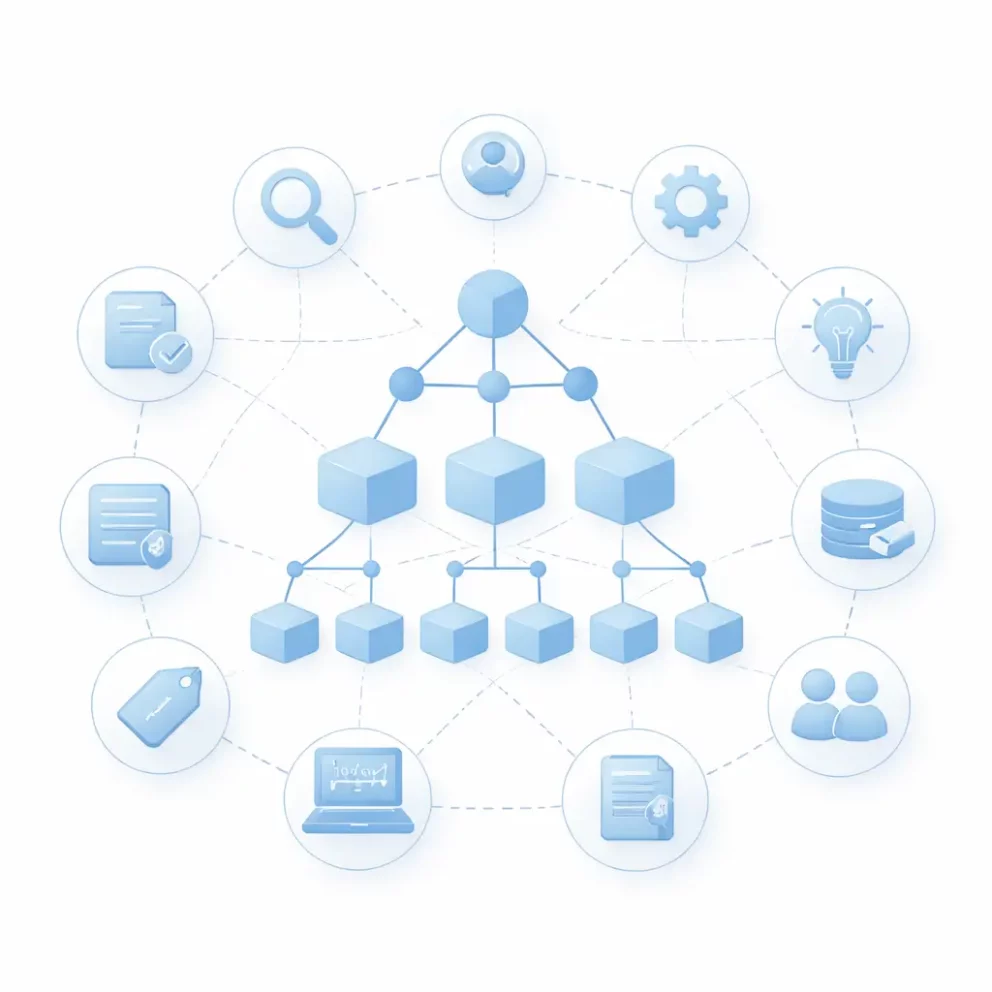
Essential models enterprise architecture as a structured knowledge graph. Each element of the enterprise becomes a node within the architecture model:
- Business capabilities
- Business processes
- Applications and services
- Technology platforms
- Information assets
- Organisational actors
These elements are connected through defined relationships. Business capabilities are realised by processes, processes are supported by applications, and applications run on technology platforms. Because the enterprise architecture is represented as a knowledge graph, organisations can analyse complex dependencies instantly.
What is an Enterprise Architecture Ontology?
An enterprise architecture ontology is a formal knowledge model that defines the concepts and relationships within an organisation. Rather than storing architecture information as disconnected data, an ontology describes the meaning of relationships between architecture elements.
- Business capabilities and organisational objectives
- Business processes that deliver value
- Applications and services supporting those processes
- Technology platforms and infrastructure
- Information assets and data flows
- Strategic initiatives and investments
Because these relationships are formally defined, the architecture repository becomes machine-readable. This allows advanced analysis and enables artificial intelligence systems to reason about the enterprise architecture model.
Why the Ontology Matters

Structured Knowledge, Not Just Data
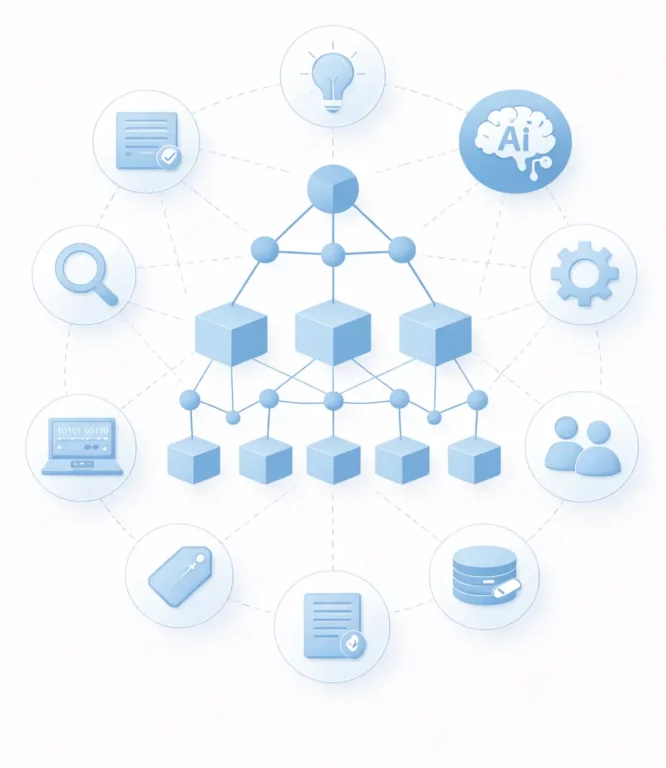
Unlike spreadsheets or wikis, Essential’s ontology captures not just what exists in your enterprise, but the meaning of the relationships between things. An application doesn’t just ‘exist’ – it supports specific business capabilities, business processes, data of defined types, runs on particular technology, and serves identified groups of users. This semantic richness is what makes the data truly useful.

A Single Connected Model
The ontology connects strategy to capabilities, capabilities to processes, processes to applications, applications to technology, and technology to costs and risks, and so on. This means any question – no matter how cross-cutting – can be answered by traversing the model. ‘Which strategic objectives are at risk because of end-of-life technology?’ is a query, not a research project.

Standards-Based & Extensible
Built on open standards and shaped by systems thinking and knowledge system principles, the platform enables organisations to model, understand and evolve complex enterprises with clarity. The ontology is both rigorous and flexible. It can be extended to capture your organisation’s unique concepts without breaking the underlying structure.
AI + Essential Ontology: A Force Multiplier
Large language models and artificial intelligence systems perform significantly better when reasoning over structured data. Essential’s enterprise architecture ontology provides the structure required for AI to analyse architecture data accurately.
Natural Language Querying
Because the ontology defines clear semantics and relationships, AI models can translate natural language questions into precise queries against your architecture data. Ask ‘Where is the area of greatest risk for us?’ and get an instant, accurate answer.
Democratises architecture insights across the organisation
Intelligent Analysis & Pattern Recognition
AI can traverse the ontology to identify patterns that would take human analysts weeks to uncover: redundant application clusters, capability gaps, technology risk concentrations, and strategic misalignments. The structured ontology gives AI the scaffolding it needs to reason accurately, not hallucinate.
Accelerates analysis from weeks to minutes
Automated Impact Assessment
When a change is proposed – sunsetting an application, migrating to cloud, acquiring a company – AI can trace the full impact through the ontology: affected business capabilities, processes, impacted users, downstream data flows, regulatory implications, and cost consequences. All in seconds.
De-risks decision-making with comprehensive impact analysis
Continuous Architecture Health Monitoring
Your AI agents can continuously monitor your architecture model for quality issues, emerging risks, standards violations, and optimisation opportunities – proactively surfacing insights rather than waiting for someone to ask the right question.
Shifts EA from reactive reporting to proactive intelligence
Reliable, Grounded Responses
The critical advantage of combining AI with a formal ontology is grounding. When AI responds based on your Essential data, it’s working from structured facts about your actual enterprise – not generating plausible-sounding fiction. The ontology constrains the AI to reality, dramatically reducing hallucination and increasing trust in AI-generated insights.
Solves the AI trust problem for enterprise decision-making

Key Characteristics of Essential Cloud
- Ontology-based enterprise architecture platform
- Knowledge graph architecture repository
- Open meta-model architecture
- AI-ready architecture data
- Unlimited users and entities
- Designed for enterprise-scale architecture modelling
Enterprise Architecture FAQ
An enterprise architecture tool (EA tool) is a software platform used to model, analyse and manage the structure of an organisation’s business and technology landscape. It captures the relationships between business capabilities, processes, applications, technology platforms and data.
By representing these elements within a connected architecture model, an EA tool allows organisations to understand dependencies across the enterprise, analyse the impact of change and support better decision-making around technology investments and transformation initiatives.
As organisations grow, their technology landscape becomes increasingly complex. Applications support business processes, processes deliver business capabilities, and all of these depend on underlying technology platforms and data.
In most organisations, knowledge about these relationships is spread across different teams and documents. An Enterprise Architecture tool brings this knowledge together into a single structured model of the enterprise.
By capturing the relationships between capabilities, processes, applications and technology, an EA tool allows organisations to understand dependencies, identify risks, rationalise systems and make better strategic decisions.
Without an architecture model, organisations often discover problems only after change initiatives have already begun.
As organisations grow, their business and technology environments become increasingly complex. Applications support business processes, processes deliver business capabilities, and all of these depend on underlying technology platforms and data.
Without a clear architecture model, it becomes difficult to understand how these elements relate to each other. This often leads to duplicated systems, hidden dependencies, increased operational risk and inefficient technology investments.
Enterprise Architecture provides a structured way to model and understand the organisation. By capturing the relationships between capabilities, processes, applications and technology, and the projects, regulations, ect that impact them, organisations can make better informed decisions about change, transformation and investment.
Enterprise Architecture therefore helps organisations reduce complexity, manage risk and align technology with business strategy.
An enterprise architecture tool helps organisations understand and manage the complexity of their technology landscape.
In many organisations, information about systems, processes and capabilities is scattered across spreadsheets, documents and individual teams. This fragmented knowledge makes it difficult to understand dependencies or assess the impact of change.
An EA tool brings this information together into a structured architecture model of the organisation. By modelling the relationships between capabilities, processes, applications and technology platforms, organisations can:
- Identify redundant applications
- understand technology dependencies
- Analyse the impact of change initiatives
- reduce operational and technology risk
- support strategic planning and transformation
This allows organisations to move from reactive problem solving to proactive architecture management.
An enterprise architecture knowledge graph represents the elements of an organisation as a connected network of entities and relationships. Business capabilities, processes, applications, technology platforms, data assets and organisational actors are represented as nodes, while the relationships between them define how the enterprise operates.
Unlike traditional repositories that store architecture information in isolated tables or documents, a knowledge graph allows organisations to analyse dependencies across the enterprise. For example, an architect can quickly determine which business capabilities depend on a specific application, or which processes are affected by a technology change.
By modelling enterprise architecture as a knowledge graph, organisations gain a more complete and navigable understanding of their technology landscape and operational dependencies.
An ontology defines the concepts and relationships that describe an organisation. In enterprise architecture, an ontology provides the formal structure that explains how elements such as business capabilities, processes, applications, technology platforms and data relate to one another.
Without an ontology, architecture data often becomes inconsistent and difficult to analyse because different teams describe systems and processes in different ways.
An ontology ensures that architecture information follows a consistent model of the enterprise. This makes the architecture repository easier to analyse, supports advanced impact analysis and enables artificial intelligence systems to reason about the organisation’s structure.
When enterprise architecture is built on a well-defined ontology, it becomes a powerful knowledge system rather than simply a collection of diagrams and documents.