
Connecting the Map: How EA Can Add Business Context to Geographic Risk
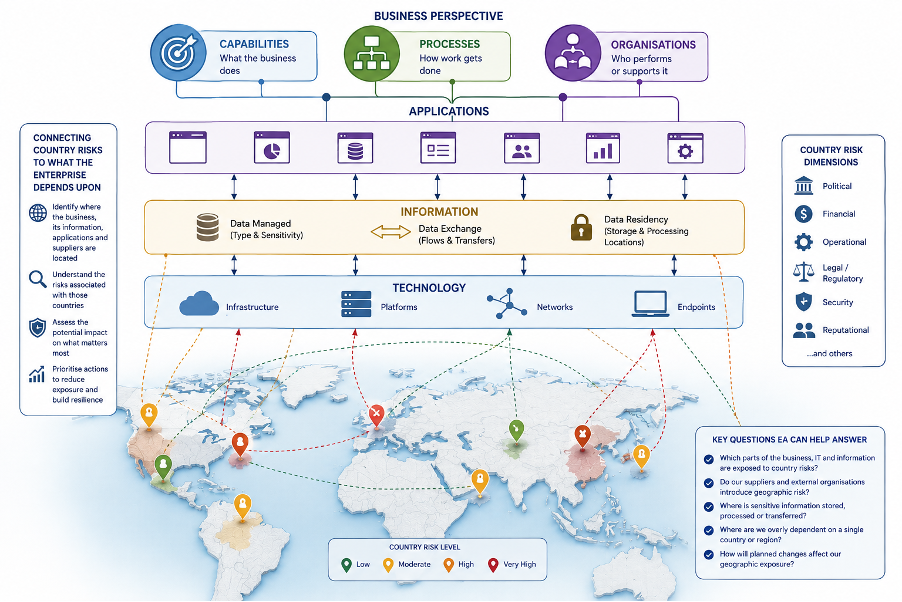
For many organisations, understanding and analysing geographic risk is already a well-established and important discipline where Risk teams or external partners already monitor political instability, economic conditions, sanctions, regulatory changes, natural disasters, cyber threats and other factors associated with particular countries.
Ultimately, the fundamental question being asked is: what do these risks mean for my business?
Typically, the output from these teams are reports and charts that, in broad terms, help the business understand, at the time of writing, the potential implications of the identified risks to the business.
Knowing that a country represents an increasing risk to my business is useful. Knowing which specific parts of your business, applications, technology, suppliers and data could be affected by that risk is considerably more useful.
This is an area where Enterprise Architecture (EA) teams are in the ideal position to add significant value, and they don’t even need an exceptionally mature architecture practice to get started.
Start with what you already know
Even relatively low-maturity EA teams often have a reasonable understanding of their application portfolio: which applications support which business capabilities, processes or organisations, and in many cases, where those applications are deployed.
Add country-level risk information to that knowledge and some useful questions can immediately be explored.
If political instability, regulatory change or infrastructure problems affect a particular country, which applications are deployed there and, more importantly, which business capabilities, processes, or parts of the organisation ultimately depend on those applications?
This starts to turn a relatively abstract geographic risk into something much more tangible that business stakeholders and senior leaders in the organisation can understand.
And that is only the beginning.
Adding the technology and supplier perspective
As EA maturity develops, teams typically start connecting applications to the technologies that support them and to their suppliers.
This introduces another geographic dimension.
An application may be hosted in a relatively low-risk country, but what about the technology on which it depends? Where is that infrastructure located? Who supplies it?
The domicile of the legal entities behind key software, cloud and technology suppliers can also become relevant. Changes in sanctions, trade restrictions, export controls, taxation or local legislation could potentially affect the organisation’s ability to purchase, operate, support or renew strategically important technology.
This also exposes concentration risk. Individually, several applications may appear relatively low risk, but analysis might reveal that a large proportion of critical business capabilities ultimately depend upon suppliers or infrastructure concentrated in one geographic region.
Following the business and the data
With greater maturity, the picture can extend beyond technology.
Where are important business processes actually performed? Which are delivered by external organisations, and where are those organisations legally domiciled?
A critical process outsourced to a provider operating from a higher-risk country could represent an operational dependency that isn’t apparent from looking at the application landscape alone.
Information adds another perspective.
If EA knowledge identifies which applications manage confidential, personal or commercially sensitive information, their deployment locations can be compared with geographic legal and regulatory risks. The same applies to information exchanged between applications: where is sensitive data stored, processed and transferred, and which jurisdictions does it potentially pass through?
This can help identify potential issues around data sovereignty, privacy regulation, government access, cross-border transfers and changing local legislation.
Don’t just look at today’s map
Perhaps one of the most valuable contributions EA can make is to look forward.
Architecture teams increasingly maintain information about planned application migrations, technology changes, outsourcing decisions, cloud adoption and application decommissioning. Geographic risk can therefore become another lens through which those plans can be assessed.
A proposed migration might reduce cost and technical debt while inadvertently moving sensitive information or critical business services into a higher-risk jurisdiction. Conversely, a transformation initiative could provide an opportunity to deliberately reduce an existing geographic concentration risk.
EA can therefore help answer not only “Where are we exposed today?”, but also “How will our exposure change?”
Connecting risk to the enterprise
None of this means that EA teams should be taking ownership of assessing political, financial, legal, operational or reputational risks associated with individual countries. That expertise will understandably sit elsewhere, internally or externally.
The opportunity for EA is different.
By connecting country risk information to an increasingly rich model of business capabilities, processes, organisations, applications, technology, suppliers and information, EA can provide the missing context between a risk existing somewhere in the world and what that risk could actually mean to the enterprise.
Importantly, this doesn’t have to be a big-bang exercise. As additional layers of architecture knowledge are incrementally added, the scope and complexity of the questions that can be answered increases.
Geographic risk is yet another great example of how incremental EA maturity isn’t just about collecting more data. It is about progressively connecting that data so that the organisation can ask, and answer, more and more valuable questions.